
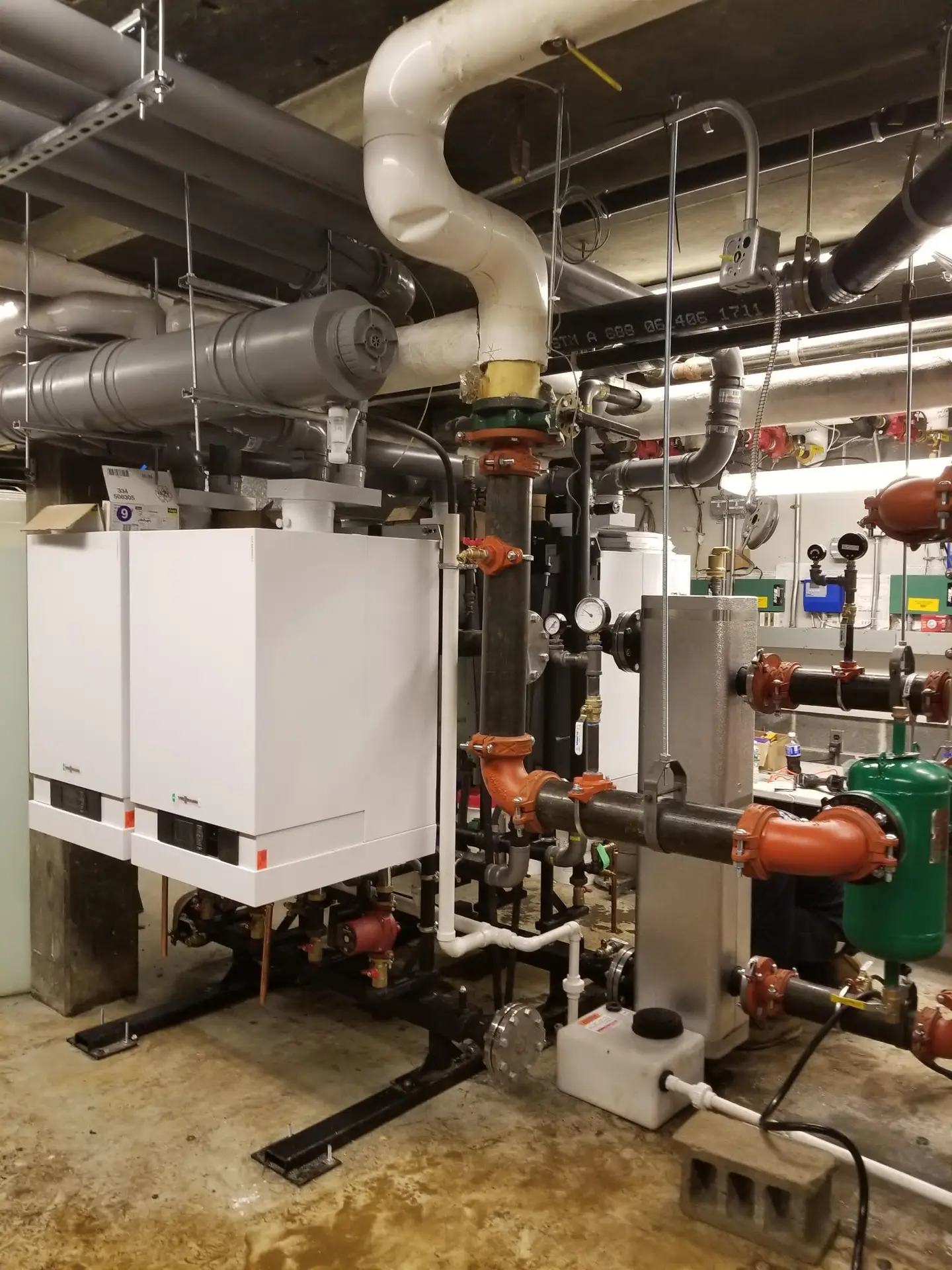
Most boilers on the South Shore sit idle or run only for hot water from May to October. The first cold night is when a weak part finally shows itself, and it is also when every heating company is busiest. A little attention in October goes a long way.
What you can check yourself
- Pressure gauge. On a typical residential hot water boiler, the gauge should read about 12 to 15 psi when the system is cold. Much lower can mean a leak or air in the system. Much higher, or a dripping relief valve, often points to a failed expansion tank.
- Leaks and stains. Look under the boiler and along the near-boiler piping for drips, rust streaks or white crust on fittings and valves.
- Vent pipes. High-efficiency boilers vent through white PVC on the side of the house. Make sure the intake and exhaust are clear of leaves, nests and plantings, and keep them clear of snow all winter.
- Carbon monoxide detectors. Test them and replace the batteries. Detectors themselves wear out, so check the date on the back.
- Clearance. Move storage boxes, laundry and anything flammable away from the boiler.
If you have a steam boiler, also check the water level in the sight glass. It should be about half full. Steam systems need a little more attention, which is why we recommend having a technician walk you through yours.

What a proper boiler service covers
- Cleaning the burner and heat exchanger, and replacing the nozzle and filter on oil boilers
- Combustion testing with an analyzer, so the burner is set for safe, efficient operation instead of guessed at by eye
- Checking the low-water cutoff, relief valve, expansion tank and circulators
- Cleaning the condensate trap and neutralizer on high-efficiency (condensing) boilers
- Checking the venting and safety controls and looking for leaks at the heat exchanger
An annual service is also usually required to keep the manufacturer warranty valid. If you have ever had a warranty claim questioned, the first thing asked for is the service history.
Signs to call before it gets cold
- Banging, kettling or gurgling when the boiler starts up
- Radiators or baseboard that heat unevenly or have cold spots at the top (see our post on bleeding radiators)
- A relief valve that drips, or a pressure gauge that climbs when the boiler runs
- Soot, a smell of exhaust, or a pilot or burner flame that looks lazy and yellow
- A boiler past 20 years old that needed repeat repairs last season
If yours is getting up there in age, it is worth reading our repair-or-replace guide now. Replacing in October is a planned project. Replacing in January is an emergency.
Fall boiler service
Book it before the first cold night
Our technicians clean, test and tune gas, oil and propane boilers across the South Shore. Ask about the Total Care Club, our yearly maintenance plan.
Schedule boiler serviceQuestions about your boiler? Call 3R Plumbing & Mechanical at (781) 974-5239.